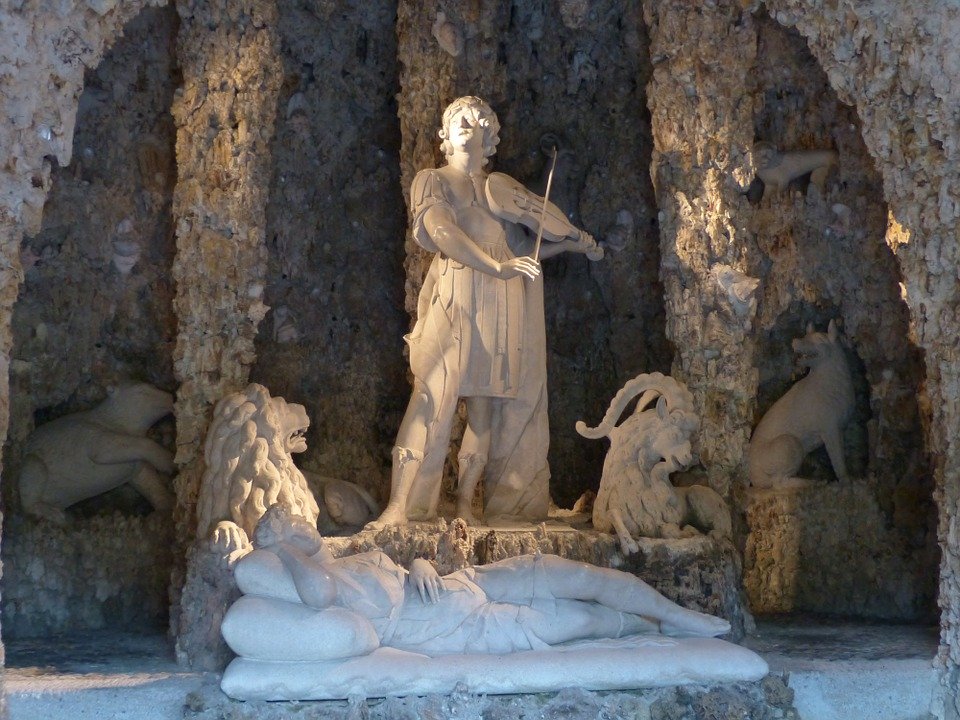
It is strange, perhaps, that one of the most haunting stories from antiquity is not about a great war or a king’s triumph, but about a simple mistake made in the depths of the underworld. Orpheus, the greatest of musicians, who could bend trees and rivers to his song, is given the chance to recover his beloved Eurydice from the realm of the dead. All he must do is walk ahead, keep faith in the gods’ bargain, and resist the temptation to turn around until they reach the light. And yet, just before reaching the world of the living, he turns. He looks back. He cannot help himself. And in that instant, Eurydice vanishes forever. It is a story of love, grief, and the inherently human desire to control what lies beyond our reach.
For centuries, this myth has haunted poets, philosophers, and artists, and for good reason. It is, at its core, about the fragility of trust, the peril of doubt, and the limits of human control over fate. Yet as we bring the story into our present moment, it resonates not simply as an allegory of romantic devotion, but as a mirror to our political and cultural age. In a society dominated by attempts to master every variable, to control narratives, to bend outcomes to our will, the myth of Orpheus and Eurydice takes on a fresh urgency. We are surrounded, it seems, by the temptation to look back; at what we have lost, at the ghosts of old certainties, and in that act, we risk losing sight of what lies ahead.
The first thing to note about the myth is that Orpheus’s failure is not malicious. It is born of love, of longing, and perhaps even of insecurity. He cannot trust that the gods will honor their word, that Eurydice is truly behind him. He must confirm it with his own eyes. There is something profoundly modern in this. We live in an era of mistrust, where faith in institutions, leaders, and even in one another, is fragile at best. The promise that things will improve, that sacrifice will lead to reward, feels hollow to many. And so, like Orpheus, we demand proof. We look back. But in so doing, we often undo the very conditions of success.
This paradox is reflected across our political landscape. Leaders, parties, and citizens alike seem unable to resist the urge to reach backwards, to grasp for an imagined past in which things were simpler, clearer, more certain. The slogans themselves betray the longing: “Make America Great Again,” “Take Back Control,” “Return to Normalcy.” These are Orphic refrains, backward glances toward a world that is no longer there, if it ever truly was. The promise is that by looking back, by reviving what has been lost, we can recover something precious. But just as Orpheus learned, the backward glance can destroy the very possibility of renewal. Nostalgia masquerades as hope, but it often leaves us empty-handed, standing alone on the threshold of a vanished dream.
And yet, we cannot deny the power of the temptation. Control, after all, is not only a political desire; it is a human one. The myth of Orpheus reveals this with cruel clarity. Even the most gifted among us, those with talents so extraordinary that nature itself bends to their will, are powerless before fate. Orpheus could charm Hades and Persephone, could accomplish what no mortal had done before, and still he could not master his own doubt. In our time, the analogy is not to music, but to technology, economics, and information. We can manipulate genomes, engineer financial systems of dizzying complexity, and flood the world with torrents of data. We convince ourselves that with enough innovation, enough control, we can bend even the harshest realities to our will. Yet again and again, the illusion shatters. Financial crises erupt, pandemics humble the strongest economies, wars and climate events remind us that our control is partial, fragile, provisional. Like Orpheus, we may win a reprieve from death, but we cannot abolish it.
The myth lingers because it speaks to something primal about the human condition: the desire not simply to live, but to reverse loss. Orpheus does not ask the gods for riches or power. He asks only for what has already slipped away. This, too, is deeply resonant today. Whole movements and ideologies are built on promises of restoration: restoration of jobs, of communities, of ways of life that globalization or modernity have eroded. Restoration of traditions that no longer command consensus. Restoration of an imagined order where things were more predictable, where one could trust in the shape of the future. These promises are powerful, but they are often no more attainable than the resurrection of Eurydice. For even if we manage to bring fragments of the past into the present, they cannot be sustained under the gaze of doubt. The moment we test them, the moment we look too closely, they dissolve.
And here lies another dimension of the story: control and doubt are intimately linked. Orpheus looks back because he cannot trust. He must see. But in seeking control, he loses everything. Our politics is riddled with this same tragic impulse. Surveillance, misinformation, culture wars; all are born of a desire to confirm, to prove, to seize control of the narrative. Leaders cannot allow processes to unfold; they must verify, manage, and manipulate. Citizens cannot simply trust institutions; they must scour the internet for hidden truths. The result is a society of perpetual backward glances, a people unable to walk steadily toward the light because we are forever craning our necks to confirm that what we value is still with us.
Perhaps it is no accident that the Orpheus myth has been so beloved by artists. It is, after all, a story about the limits of art, the boundaries of human persuasion. Music can charm even the rulers of the underworld, but it cannot overcome human frailty. What does it mean, then, for us to live in a culture where art itself is so frequently co-opted into the machinery of politics? Every song, every film, every myth is repurposed for a cause, every image pressed into the service of some agenda. In this sense, our culture too suffers from the Orphic temptation: art is not allowed to exist in trust, as something that guides us without proof. It must be scrutinized, harnessed, forced to confirm our beliefs. And in this process, much like Eurydice, the art we loved can vanish.
Yet there is also a note of tragedy that makes Orpheus’s story enduring rather than simply didactic. We sympathize with him. Who among us would not look back? Who among us could resist the need to confirm that what we love most is truly there? His failure is not villainy but humanity. And it is this humanity that makes the myth so fitting for our present. The longing to control, to verify, to hold onto what we love; this is not the weakness of a few, but the burden of us all. In politics, as in love, we are asked to trust, to walk forward without guarantees. The tragic truth is that often we cannot.
What, then, is the lesson for us today? It would be easy to moralize, to say simply: do not look back, learn to trust, resist the urge to control. But such advice is too simple. The myth endures not because it offers a neat solution, but because it confronts us with the impossibility of perfection. Orpheus’s failure reminds us that no bargain with the gods is ever secure, no trust ever absolute, no control ever complete. The question is not whether we will look back, as we undoubtedly will, but what we will do when we realize the cost. Will we, like Orpheus, retreat into grief and song, lamenting what we have lost? Or will we accept the impermanence, and walk forward knowing that the light itself is enough, even if it does not restore what was taken?
In our modern political life, this question is urgent. Movements built on nostalgia, on promises of restoration, are powerful because they appeal to our deepest fears of loss. But they are dangerous because they risk trapping us in an endless cycle of backward glances. If we are forever trying to revive what has passed, we may never build what could be. And yet, if we deny the power of loss altogether, if we pretend that grief and longing do not matter, we sever ourselves from what makes us human. The challenge, then, is to live with both: to honor the memory of Eurydice without demanding her return. To acknowledge what is gone, and yet still walk forward.
Perhaps this is what makes the myth not simply tragic, but instructive. Orpheus loses Eurydice, but in so doing, he bequeaths to us a story that has shaped centuries of art and thought. His failure becomes our inheritance, a reminder that even in loss there is creation. And maybe this, too, is a message for our politics. The past cannot be restored, but it can inspire. The longing for what has been lost can be transmuted into the energy to build anew. The temptation to control may never be overcome, but it can be redirected; from the futile attempt to master fate, toward the more modest, but no less noble, task of shaping the present with honesty and courage.
In the end, the myth of Orpheus and Eurydice does not tell us never to look back. It tells us that when we do, as we inevitably will, we must learn to live with the loss, and not let it paralyze us. Our culture and politics today are filled with backward glances, with the desperate need to prove, to control, to restore. If we can learn anything from the poet and his beloved, it is that such control is illusory, and that our true task is not to command the past, but to step forward into the light, uncertain but unafraid.
 For The Love Of Classics