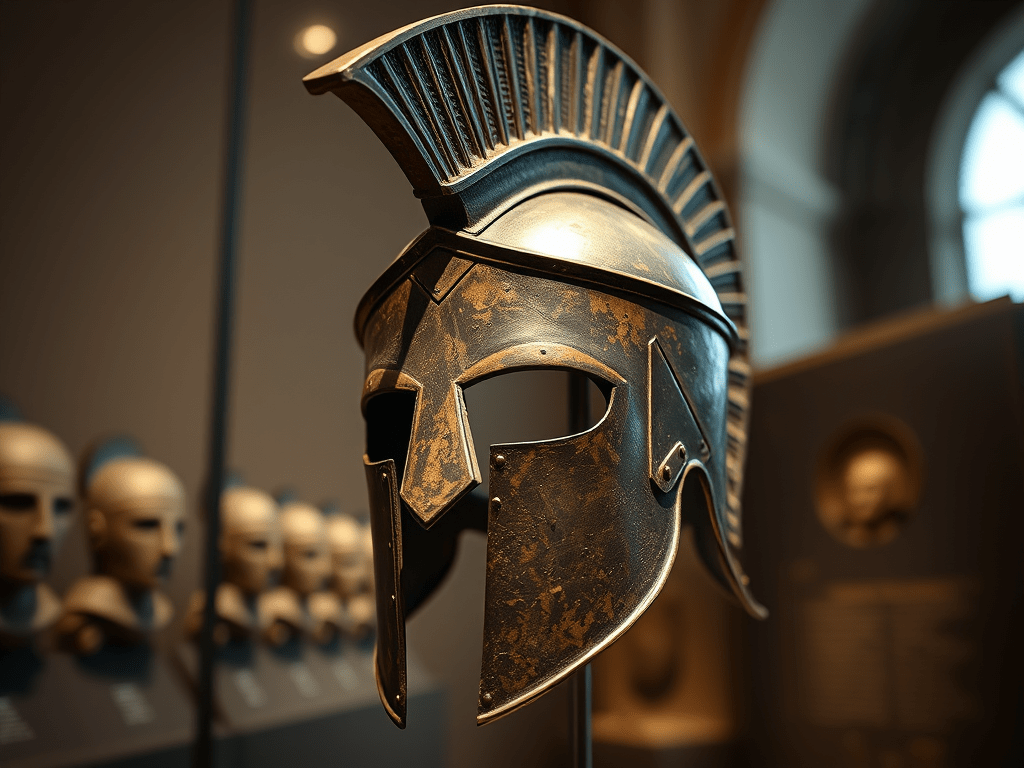
Bring up Sparta at a dinner party and watch what happens. Someone will mention 300, someone will mention discipline, someone will mention a gym they used to belong to that had a red cape on its logo, and within about four minutes the table will have split into two camps that were not, until that moment, aware they held such strong opinions about a Greek city-state that stopped mattering politically some twenty-three hundred years ago. I have watched this happen more times than I can count, and I no longer find it surprising. What I find interesting is the shape of the argument itself, because it is nearly always the same argument, wearing different clothes, and it rarely has much to do with Sparta at all.
Here is the detail that ought to unsettle anyone entering this conversation with confidence: Sparta did not write its own history. Not in any sustained way, not in the manner Athens did, with its historians and its orators and its playwrights producing an enormous, self-documenting archive of civic argument. Sparta’s citizens were famous for terseness, for the clipped, unadorned style that gives us our word laconic, drawn from Laconia, the region around Sparta; and whatever they thought of themselves, they mostly kept it to themselves, or communicated it in a handful of words rather than a treatise. Nearly everything we think we know about how Sparta actually functioned comes to us from outsiders, and often from outsiders with an agenda of their own. Herodotus, writing a generation or two after the Persian Wars, was fascinated by Sparta but was not Spartan. Thucydides, an Athenian general in exile, gives us the most reliable contemporary military detail we have, but he was writing the history of a war between Athens and Sparta, and he had his own city’s failures very much on his mind while doing it. Xenophon actually lived among the Spartans for years, sent his sons to be educated in the agoge, and wrote a treatise in praise of the Spartan constitution; he is our fullest source and also, by his own admission, an enormous admirer, which ought to make us read him with one eyebrow raised. And Plutarch, from whom most people actually get their picture of Sparta, the newborns inspected on the shields of the elders, the boys stealing food and being beaten not for the theft but for getting caught, was writing his Life of Lycurgus something like four hundred to six hundred years after the events he describes, drawing on sources that were already legendary in his own day. A French scholar named François Ollier gave this problem a name in the 1930s that classicists still use: le mirage spartiate, the Spartan mirage. We are not looking at Sparta. We are looking at a reflection of Sparta refracted through several centuries of people who each had their own reasons for wanting it to look a certain way.
That matters enormously for how the argument at your dinner party actually proceeds, because both sides are usually drawing water from the same mirage and simply choosing to see different things in it. The admirer looks into it and sees a society that solved the oldest political problem there is, the tension between the individual and the collective, by simply deciding the collective wins, cleanly and without apology; a city where a boy belonged to the state from the age of seven, where private wealth was suppressed in favor of communal messes called syssitia at which every full citizen was required to dine, where the entire structure of life was engineered to produce soldiers who would not break formation even as their friends died to the left and right of them. The critic looks into the same mirage and sees a totalitarian nightmare with excellent public relations: a krypteia, a secret police force of young Spartan men sent out annually to live off the land and, according to both Plutarch and Aristotle, to kill any helot found wandering alone at night as a matter of state terror; a society that formally declared war on its own slave population every year specifically so that killing a helot would carry no religious pollution, since you cannot commit murder against an enemy in a state of formal war; a system that reduced women to broodmares for future soldiers, or, in an irony the ancient sources themselves noticed, gave Spartan women a degree of independence, physical education, and property control that scandalized the rest of Greece, Aristotle included, who complains in the Politics that Spartan women had come to own something like two-fifths of all the land in Laconia and that this, in his view, was a significant part of what eventually broke the state.
That last detail deserves a moment, because it cuts against nearly everyone’s tidy narrative. Aristotle, writing after Sparta’s collapse as a great power, does not blame effeminacy or moral decline in the way modern admirers of Spartan toughness might expect. He blames a demographic and economic failure. The number of full Spartan citizens, the homoioi, the “equals” who alone could serve in the phalanx and vote in the assembly, had been shrinking for generations, a phenomenon the Greeks called oliganthropia, literally the scarcity of men. By the time of the disaster at Leuctra in 371 BC, when a Theban general named Epaminondas broke the myth of Spartan invincibility on an open battlefield using a deliberately unbalanced phalanx formation, Sparta may have had as few as a thousand adult male citizens left standing behind the whole apparatus of the state. The system that was supposedly built to produce the perfect soldier had, over two centuries, produced fewer and fewer of them, in part because land was concentrating in fewer hands, including, as Aristotle notes, the hands of Spartan women who could inherit and control property in a way Athenian women simply could not. The most militarized society in the Greek world lost its wars not because its soldiers went soft but because there stopped being enough soldiers, and the reasons for that had rather more to do with inheritance law than with courage.
Underneath the whole citizen apparatus, and vastly outnumbering it, sat the helots, the conquered population of Messenia, reduced to a kind of state-owned serfdom generations before Athens had refined its own, differently structured practice of slavery. Every Spartan citizen’s ability to spend his adult life training for war rather than farming his own land depended on helot labor, and the Spartans knew perfectly well how outnumbered they were by the people they had subjugated; Thucydides tells us, almost in passing, that after an earthquake in 464 BC touched off a massive helot revolt, the Spartans on one occasion lured out two thousand helots who had distinguished themselves in service, crowned them as a mark of honor and a step toward freedom, paraded them around the sanctuaries, and then made every one of them disappear, and nobody, Thucydides writes, ever learned how each one had been killed. That is not a society defending itself against an external enemy. That is a ruling class managing an internal population it knew, at some level, it could not fully control by ordinary means, and doing so with a level of calculated brutality that the admirers of Spartan discipline tend to leave out of the toast.
And then there is Thermopylae, which is really where all of this ends up, because Thermopylae is the image that swallowed the argument whole. Herodotus gives us the account most people know in outline even if they have never opened a book of him: Leonidas and three hundred Spartans holding a narrow pass against the entire Persian army under Xerxes for three days, buying time for the rest of Greece, dying to the last man once betrayed and outflanked. It is a genuinely extraordinary story and Herodotus tells it with real narrative force. It is also, in the way it has come down to us, missing several hundred people. There were Thespians at Thermopylae who chose to stay and die alongside the Spartans, and there were Thebans present as well, under considerably more compulsion, and depending on which count you credit, several thousand other Greek troops fought in the earlier days of the battle before the final stand. The number three hundred is true and also does a great deal of quiet editorial work, because three hundred is a story about Spartans, and several thousand assorted Greeks from cities that history has treated far less generously is a story about something messier and more collectively Greek. Frank Miller’s 300, and the 2007 film made from it, took Herodotus’s already-simplified version and stripped it further, into something closer to myth than history, and it is largely through that film, and through the CrossFit gyms and mixed martial arts promotions and recruiting posters that borrowed its aesthetic afterward, that most people under a certain age have absorbed their entire idea of what Sparta was. “Molon labe,” come and take them, Leonidas’s supposed reply when asked to lay down his arms, shows up on gun range walls and bumper stickers today with no sense that its adopters are quoting a possibly apocryphal line, reported centuries later by Plutarch, from a battle their own political tradition has almost nothing else in common with.
That branding question is worth sitting with a little longer, because it is not confined to one part of the political spectrum, whatever the impression left by any single argument at any single dinner table. The aesthetic of Spartan toughness has been claimed by military recruiters, by obstacle-course racing companies who put the word Spartan directly in their name, by fitness culture broadly, and, less comfortably, by extremist movements on both ends of the ideological spectrum who have found in the phalanx and the shield-wall a convenient visual shorthand for whatever kind of unyielding collective solidarity they happen to be selling that year. None of these appropriations are actually arguing about ancient history. They are borrowing a costume, and the costume fits so many different arguments precisely because the mirage underneath it is vague enough to project almost anything onto.
Which brings me back to the dinner party, because I think that vagueness is the whole answer to why we are still doing this, twenty-five centuries on. Sparta never left us enough of its own voice to argue with directly. What it left us instead is a shape, filtered through Athenian rivals, laconizing philosophers, imperial-era biographers, and now movie studios and marketing departments, and the shape is capacious enough that whatever you already believe about the proper balance between the individual and the collective, about discipline and its costs, about whether a well-ordered society is worth the freedoms it asks you to surrender, you can find a version of Sparta that confirms it. The person who admires discipline finds the syssitia and the agoge and reads them as a rebuke to a soft age. The person who prizes individual liberty finds the krypteia and the helots and reads them as the logical endpoint of any society organized entirely around the state’s convenience. Both readings are supported by real evidence and both are also, in their own way, projections, because the actual Sparta, the one that existed day to day for the people who lived in it, is simply not available to us in enough detail to settle the argument on the historical merits alone.
I find that I have come to like Sparta less as a subject to have an opinion about and more as a kind of diagnostic instrument, a Rorschach test built out of an entire civilization. What you see in it tells you rather more about what you already value than it tells you about the fifth century BC. The most honest thing a modern historian can do with Sparta, and scholars like Paul Cartledge and Stephen Hodkinson have spent careers doing exactly this, is to keep pointing out where the mirage is thinnest and where the sources contradict each other and where our own certainties are running ahead of the evidence. It is less satisfying than picking a side. It also happens to be the truth of the matter, and if there is one thing worth taking from twenty-five hundred years of arguing about a city that mostly declined to explain itself, it might be a bit more humility about how much of what we are certain we know about it is actually us, looking into an old mirror and admiring, or condemning, our own reflection.
I would be curious to hear which version of Sparta you were handed first, and whether anything here has moved it.

