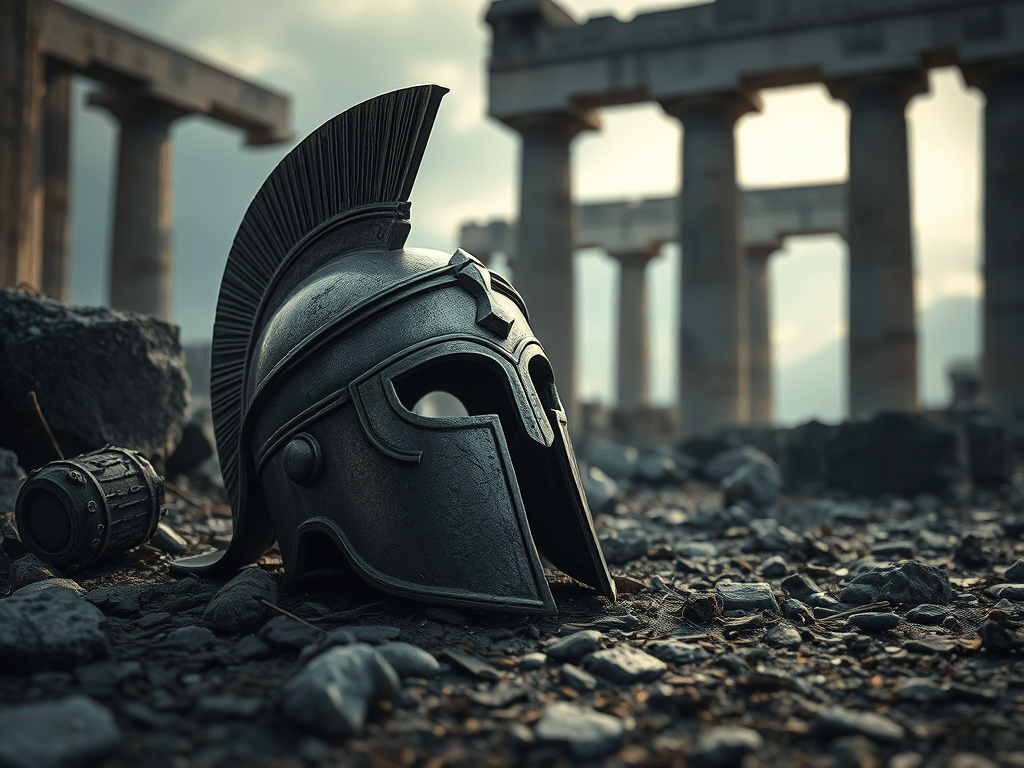
The Shadow of the Hero
More than three thousand years after Homer sang of his rage, Achilles continues to haunt our imagination. He appears in epics and tragedies, in Renaissance painting and modern novels, in video games, films, and even memes. Perhaps no other warrior of antiquity casts so long and so complicated a shadow.
But why should a half-mythical hero of the Trojan War still matter to us? A potential answer lies not only in the brilliance of Homer’s poetry, but also in the timeless human questions that Achilles embodies: Why does the pursuit of glory remain such a steadfast ideal? Why the inevitability of death lord over us as a tragic thought from the moment that we can realistically perceive space and time? Further, what of the true nature of friendship, if there is any such thing? How do we maintain the tension between rage and compassion, and which ultimately drives us?
Achilles lingers with us because he dramatizes what it means to be human at its most extreme; a doomed man torn between greatness and mortality, and the very black-and-white choices that accompany those potential outcomes.
The Rage that Opens the West
The Iliad begins not with Troy or Helen or even the gods, but with a single explosive word: Mēnin, or rage. From the first line, Achilles’ wrath sets the terms and the scope of the story. His quarrel with Agamemnon over honor, a temporarily defining refusal to fight, and his eventual re-entry into battle all spring from the deepest well of human emotion and the perception of status and respect derived from leadership and friend alike.
In literary history, this matters intensely. The Western tradition of storytelling begins with a portrait of anger: not love, not duty, not patriotism. Achilles is neither a saint nor a statesman; he is a man consumed by a primal sense. In him we recognize the raw, destructive force of wounded pride, the kind of rage that drives both private feuds and public wars alike.
That opening note reverberates through millennia. Shakespeare’s Troilus and Cressida, Milton’s Paradise Lost, and even modern antiheroes like Tony Soprano or Walter White inherit something of Achilles’ mixture of fury, vulnerability, and charisma. The world cannot look away from him, nor can it stop telling his story.
Glory vs. Life: An Impossible Choice
At the heart of Achilles’ legend lies this choice. According to tradition, his mother, Thetis, told him that he faced two fates: a long, obscure life at home or a brief, blazing existence of glory at Troy that will echo through eternity.
This dilemma has consumed mankind through the centuries because it confronts us with a question we never quite escape: is it better to live safely, or to burn brightly? Achilles chooses glory, and in doing so, he embodies the tension between ambition and timidity, immortality and mortality.
Modern culture is obsessed with this same choice. We see it in athletes who risk their bodies for fleeting triumphs, in artists who sacrifice stability for their craft, in soldiers who lay down their lives for country or comrades. We even joke about it with the phrase “live fast, die young.” Achilles’ decision is our own, amplified to mythic scale.
Friendship, Love, and Loss: Patroclus’ Shadow
If Achilles were only a vessel of rage and glory, he might not matter so much. However, he also shows us the depths of love and its accompanying grief. His bond with Patroclus, whether we interpret it as friendship, brotherhood, or romantic love, serves as the emotional core of the Iliad.
When Patroclus dies at Hector’s hand, the unyielding warrior collapses into a grief so profound that it redefines him. His anger turns outward again, but now it is sharpened by loss. As such, he fights not for pride or even Greece, but to avenge the one that he loved, his dear friend.
This is why Achilles speaks to us: his inhuman strength is tethered to the most human of experiences; namely, mourning. His lament for Patroclus resonates across cultures. From Michelangelo’s sculptures to Madeline Miller’s The Song of Achilles, artists return again and again to this grief, because it shows the heart of the hero and humanizes him further to the audience.
Achilles the Antihero
Unlike many later heroes, Achilles is not morally simple. He abandons his comrades in their time of need. Later, he desecrates Hector’s body in a fury that horrifies even the gods. It is certainly possible to argue that he is as much a danger to his own side as to the Trojans.
This complexity makes him feel startlingly modern. Where earlier generations celebrated simple heroism, our age tends to embrace the antihero: figures who are flawed, morally ambiguous, even destructive, yet compelling. Achilles belongs alongside Hamlet, Heathcliff, or Batman’s darker incarnations.
In an era of skepticism toward uncomplicated heroism, Achilles endures because he already embodies contradiction. He is noble and savage, compassionate and cruel, almost divine in some ways, yet inescapably mortal in those that matter most.
The Turning Point: Compassion for the King
And yet, the most haunting moment in the Iliad is not Achilles’ wrath or his triumphs, but his tears. When Priam, king of Troy, sneaks into the Greek camp to beg for his son Hector’s body, Achilles finally breaks.
He sees in Priam’s grief the reflection of his own father’s fate, the losses still to come, and the shared mortality that unites enemies. In this moment, Achilles becomes more than a warrior; he becomes human in the fullest sense. He weeps with Priam, restores Hector’s body, and recognizes that even in war, compassion is possible.
This scene has transfixed readers for centuries because it moves beyond rage and vengeance to something more enduring. It asks us whether empathy can break through cycles of violence. Achilles haunts us not just because he rages, but because he weeps, as do we all.
Achilles in Later Imagination
Every age remakes Achilles in its own image:
- Ancient Greece – dramatists emphasized his rage and his grief, making him a cautionary figure.
- Rome – poets like Statius presented him as the ultimate martial model, both admired and feared.
- The Middle Ages – Christian writers grappled with Achilles as a pagan warrior, sometimes condemning him as proud, sometimes admiring his courage.
- The Renaissance – artists and playwrights revived him as a figure of beauty and tragic greatness.
- The Modern Age – novelists like Madeline Miller (The Song of Achilles) and films like Troy (2004) humanize him for new audiences, often through his bond with Patroclus.
Why do we keep returning to him? The answer is simple…because Achilles can be molded to fit our aspirations and our anxieties. For a militaristic age, he is the ultimate warrior. For a romantic one, he is the grieving lover. For us, perhaps, he is the flawed antihero who must learn empathy in a violent world.
Achilles and Us
At the deepest level, Achilles endures because he mirrors us. His struggle is not ancient, but eternal:
- We too wrestle with anger, whether personal or political, and its destructive, consuming power.
- We too face the choice between safety and ambition, between comfort and greatness.
- We too endure grief and loss and know how love can drive both despair and renewal.
- We too live with contradiction, capable of cruelty and compassion in the same breath.
Achilles is larger than life. Yet, as a man, he reminds us that to live is to strive, to rage, to grieve, and, at last, to reconcile ourselves to mortality.
The Eternal Hero
Why does Achilles still haunt us? Because he refuses to be easily defined. He is not just a warrior, not just a lover, not just a mourner, but all of these archetypes together. His story is not about victory, but about the human condition: fierce, fragile, finite, flawed.
Homer’s words have echoed across three millennia, but Achilles endures because we recognize him in ourselves. We see in his wrath our own anger, in his grief our own losses, in his choice our own ambitions, and in his compassion the hope that even in the darkest conflicts, humanity can break through.
Achilles haunts us because he will not let us forget that greatness and mortality are inseparable, and that even the most unstoppable warrior must one day lay down his arms and weep before passing on.
 For The Love Of Classics